


Pentagon strips former Air Force secretary's clearance over alleged classified leak about Air Force One
The Department of War revoked former Air Force Secretary Frank Kendall's security clearance and barred him from holding any sensitive government position, accusing him of leaking classified details about Air Force One to the press.
Chief Pentagon spokesman Sean Parnell announced the move on August 7, posting on X that the revocation was effective immediately. Parnell tied the action directly to what he called Kendall's "unauthorized disclosure of classified information regarding Air Force One's capabilities to a media outlet." He did not name which outlet received the information, and he offered no word on whether the Justice Department would pursue criminal charges.
Kendall, a lawyer and engineer who led the Air Force from 2021 through January 2025 under President Joe Biden, denied the accusation. He told the Associated Press that he was "completely mystified" by the Pentagon's decision and insisted he had never disclosed classified material.
"I've always been extremely careful to not say anything classified, and as far as I know I have not. No one has said anything to me about what I'm asserted to have revealed and I can't imagine what it could be."
Kendall also told the AP he had been "comfortable being on the record with reporters and on national television about the Qatari 747" because he was "confident that I haven't said anything classified." But the Pentagon clearly disagreed, and the timeline of Kendall's public statements about the aircraft's security shortcomings paints a picture of a former official who had plenty to say.
Kendall went on a media tour questioning the Qatari jet's readiness
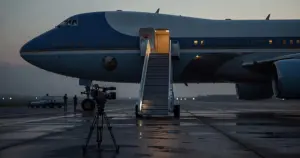
At the center of the dispute is a Boeing 747-8 that Qatar gave President Trump, a gift valued at roughly $400 million. The Air Force retrofitted the aircraft for presidential use, and Trump flew it to last month's NATO summit in Turkey before returning aboard an older Air Force One.
Kendall spoke to multiple outlets about what he described as serious deficiencies in the jet's conversion. He told CNN the Qatari plane would have needed three to four years of work to match the security standards of the older presidential aircraft. He told NPR that "a month is not enough time to do anything significant" and said he had "a hard time imagining" any meaningful hardware modifications that could be completed in that timeframe, the Washington Examiner reported.
The New York Times separately reported that the Qatari jet lacked the antimissile protections of the plane it replaced. The Air Force itself conceded it had deliberately left out several complex engineering upgrades when converting the donated aircraft. That concession lent weight to the press coverage, but it also raised the question of whether Kendall's on-the-record commentary crossed the line from public opinion into classified territory.
The administration has taken the broader press coverage seriously. The Justice Department subpoenaed New York Times reporters over their coverage of the Qatari jet's security gaps, though a judge faulted the department's handling of the case and the subpoena demands were dropped last month.
Parnell's message left no room for ambiguity
Parnell's full statement framed the revocation as a matter of principle, not politics. He wrote on X that "safeguarding classified information is a non-negotiable duty" and added that "those who violate that trust forfeit the privilege of access and any role requiring it."
The statement did not specify which of Kendall's public remarks constituted the alleged breach. It did not identify the media outlet involved. And it gave no indication that formal charges were forthcoming. The AP noted the absence of any word on prosecution.
That gap matters. Revoking a former official's clearance is an administrative action the Pentagon can take unilaterally. Prosecuting a leak is a different matter, one that requires the Justice Department to prove that specific classified material was disclosed and that the disclosure was unauthorized. Kendall's claim that nobody has told him what he allegedly revealed suggests the government has not yet made its case to him directly, at least not through any channel he has acknowledged.
The administration has shown it is willing to go further when it believes leaks threaten national security. President Trump has demanded jail time for leakers in the past, and the Justice Department's now-dropped subpoenas against Times reporters showed the administration's willingness to use legal tools aggressively to trace the source of damaging stories.
Kendall is not the first former official to lose clearance access under this administration
Defense Secretary Pete Hegseth pulled the security clearance of retired Gen. Mark Milley, the former chairman of the Joint Chiefs of Staff, shortly after the administration took office. That move signaled early on that the Pentagon under Hegseth would not treat clearance access as an entitlement for former officials who had fallen out of favor.
The pattern extends beyond the Pentagon. Former Secret Service Director Kimberly Cheatle had her top-level clearance revoked after Republican congressional opposition, particularly from Sen. Ron Johnson of Wisconsin, who investigated the agency's failures surrounding the July 2024 assassination attempt on Trump at a rally in Butler, Pennsylvania. Current Secret Service Director Sean Curran made the determination as part of what the agency called a modernization of its intelligence apparatus.
The AP reported that the administration has revoked the clearances of 37 former national security officials in total. That number puts the Kendall action in a broader context, this is not a one-off response to a single story but part of a systematic effort to restrict access for former officials the administration views as having abused their positions or their access.
And the consequences for mishandling classified material can be severe. Former National Security Adviser John Bolton pleaded guilty to retaining classified documents and faced up to five years in prison, a reminder that the government treats these matters as criminal, not merely administrative, when it chooses to.
Kendall's post-office conduct drew a clear line
Since leaving his post in January 2025, Kendall has publicly criticized the Trump administration. He currently serves as a senior fellow at the Center for American Progress, a left-leaning Washington think tank. His willingness to go on the record with CNN, NPR, and the AP about what he saw as deficiencies in the Qatari jet's conversion put him squarely in the crosshairs of an administration that has made clear it will not tolerate what it considers unauthorized disclosures.
Whether Kendall's public statements actually contained classified information remains an open question. He insists they did not. The Pentagon says they did. No one has publicly identified the specific classified detail he allegedly revealed.
The Fox News report on the revocation noted that the action appeared connected to Kendall's quotes in press coverage detailing capability differences between the Qatari-donated Boeing 747-8 and the older presidential aircraft. The Breitbart report pointed out that Trump himself later acknowledged the plane needed upgrades by announcing it would be taken out of commission to be "maxed out."
That acknowledgment complicates the administration's position slightly, the president's own public statements confirmed the aircraft needed further work, which is roughly what Kendall had been saying. But there is a difference between a sitting president choosing to disclose information about his own aircraft and a former official freelancing to the press with details that may or may not have been classified.
The Pentagon's decision to act against Kendall also comes at a time when the intelligence community is undergoing significant leadership changes, with personnel decisions increasingly drawn along partisan lines.
Kendall's case raises a question the national security establishment has grappled with for years: where does informed public commentary by a former senior official end and unauthorized disclosure begin? The answer, in practice, often depends on who is making the call, and right now, the Pentagon is making it clear that the call belongs to the people still in charge.
Former officials who leave government and immediately take up positions at partisan think tanks while talking to every reporter who will listen should not be surprised when the access they once enjoyed disappears. Clearances are a privilege, not a pension benefit, and the Pentagon just reminded everyone of the difference.
