

Woman who claimed ICE held her for two days was actually at a hotel spa, federal lawsuit alleges
A Wisconsin sheriff has filed a federal defamation lawsuit seeking at least $1 million each from a woman who publicly claimed immigration agents detained her for nearly two days, and from the Cook County politician who amplified her story, after investigators say hotel records, text messages, and surveillance footage showed she spent that time at a Hampton Inn getting spa treatments and checking out the gym.
Dodge County Sheriff Dale Schmidt filed the suit Friday against Sundas "Sunny" Naqvi, a 28-year-old U.S. citizen, and Cook County, Illinois, Commissioner Kevin Morrison, the New York Post reported. The lawsuit also names 10 unidentified "John Does" and requests a jury trial.
The case centers on a story that drew national attention last month, one that fit neatly into the broader political narrative about aggressive immigration enforcement. The problem, according to federal authorities and the sheriff's own investigation, is that the story appears to have been fabricated from start to finish.
The claim vs. the evidence
Naqvi and her supporters publicly insisted she was unlawfully detained by ICE officers for roughly 43 hours after landing at Chicago O'Hare International Airport on the morning of March 5, returning from a work trip to Turkey. She claimed she was held at O'Hare for nearly 30 hours, then transferred to another ICE facility in Broadview, Illinois, before ending up at Dodge County Jail in Wisconsin.
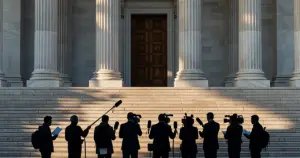
Morrison, who described Naqvi as his "best friend's sister," took the story public. On March 8, he held a media conference alongside Naqvi's sister to decry the alleged detention. He shared screenshots on Facebook that he said showed Naqvi's location at the Juneau, Wisconsin, jail. A "reunited" photo was uploaded to his Facebook page.
The Department of Homeland Security called the claims "blatantly false." On March 10, DHS posted surveillance footage from the airport and issued a statement on X:
"Ms. Naqvi departed CBP within 90 minutes of her arrival to the United States... [she] was not taken into custody or transferred to ICE for detention."
Ninety minutes. Not 30 hours. Not 43 hours. Ninety minutes, and then she walked out.
Hotel folio tells a different story
What happened next, according to the sheriff's office, is where the story collapses entirely. Schmidt said at a press conference that a hotel folio showed Naqvi checked into the Hampton Inn and Suites in Rosemont, Illinois, a 10-minute drive from O'Hare, at 1:17 p.m. on March 5. She checked out on the afternoon of March 8.
That means she was at the hotel for the entire duration of her supposed detention.
The sheriff's office also released text messages Naqvi exchanged with an unidentified witness over those days. In them, she asked to use the witness's card to order food, mentioned she was "going to check out the gym in like 5," and later texted: "May i use your card to pay my spa lady?"
The witness told police he drove Naqvi to a nearby gas station in the early hours of March 7. Surveillance footage from that outing was referenced by the sheriff's office. Morrison had claimed Naqvi was released from custody around that same time and hitchhiked nine miles to a hotel, a version that does not square with the hotel check-in record from two days earlier.
The Dodge County Sheriff's Office stated it had no record of Naqvi ever "being booked, detained, or released" at the local jail. None. The story that generated national headlines and a press conference simply had no footprint in the system it was supposed to have passed through. It's the kind of explosive allegation that crumbles under basic scrutiny, yet it was treated as fact before anyone bothered to check.
Morrison doubled down, then went quiet
Even after DHS released its footage and statement, Morrison did not back down. He accused officials of "lying" and "trying to create a cover-up." He did not respond to inquiries from the Post.
Morrison is not just any local commissioner. He is running for a seat in Congress. His decision to amplify Naqvi's story, holding a press conference, posting on social media, accusing federal officials of a cover-up, came with obvious political incentive. A story about ICE wrongfully detaining a young American citizen is the kind of narrative that builds a campaign in certain districts.
"This is a 28-year-old girl just left on the street by ICE in another state, without her property."
That was Morrison's characterization. The hotel folio, the text messages, and the surveillance footage tell a different story, one involving room service requests and spa appointments. The gap between Morrison's public claims and the documentary evidence the sheriff's office presented is not a matter of interpretation. It is a matter of fact versus fiction.
Whether Morrison knew the claims were false or simply failed to verify them before going public is one of the open questions the lawsuit will presumably explore. It was not immediately clear whether either Naqvi or Morrison had retained legal counsel. In a political environment where discredited narratives have been used before to drive political agendas, the pattern is familiar: make the accusation loudly, let the media run with it, and hope the correction never catches up.
The sheriff fights back
Sam Hall, Schmidt's attorney, framed the lawsuit in plain terms.
"This lawsuit was filed because a completely fabricated story was pushed into the national spotlight by Naqvi and Cook County Commissioner Morrison. Unfortunately, their claims were treated as fact without the most basic verification."
Hall added that the case is "ultimately about accountability" and that "Sheriff Schmidt is standing up to demand accountability against those who perpetuate lies and fake news."
Schmidt cited "reputational harm" in the filing, noting it was particularly significant as he prepares for a re-election campaign in 2026. The lawsuit seeks no less than $1 million per defendant. For a county sheriff in Wisconsin, the kind of national media coverage generated by false detention claims can do real damage, to his office, his department's credibility, and the trust of the community he serves.
Wisconsin authorities were not able to bring criminal charges in the case, according to officials. The reasons were not detailed. That left the civil courts as Schmidt's avenue for accountability, and he took it.
A story the media wanted to believe
The broader pattern here matters. A young American woman claims she was swept up by ICE. A local politician amplifies the story with a press conference and social media posts. The narrative goes national. And the basic verification, checking whether the jail had any record of the supposed detainee, pulling the hotel receipts, reviewing the airport footage, apparently did not happen until after the story had already done its damage.
This is what happens when political narratives outrun facts. The incentive structure is clear: in the current climate, an ICE detention horror story generates immediate media interest, political sympathy, and activist energy. The people who have to live with the consequences, in this case, a county sheriff smeared on a national stage, are left to clean up the mess on their own dime and their own time. It echoes a recurring problem across public life, where political figures face scrutiny only after the damage is done.
Morrison's congressional ambitions make this more than a local dispute. A man running for federal office stood before cameras and told the country that a U.S. citizen had been unlawfully detained by immigration agents, while, according to the sheriff's evidence, that citizen was texting about spa appointments from a hotel room ten minutes from the airport.
The lawsuit will proceed through the courts, and Naqvi and Morrison will have their chance to respond. But the documentary record the sheriff's office has laid out, the hotel folio, the text messages, the surveillance footage, the jail's empty booking log, presents a version of events that is difficult to reconcile with the story that was told to the American public. In an era when misleading public statements carry real consequences, the question is whether accountability will follow.
When the facts are this clear and the fabrication this brazen, a million-dollar lawsuit may be the least of what accountability demands.
