


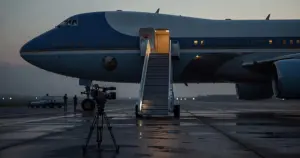
King Charles to receive display of American military power during late April state visit
King Charles is set to receive a show of "American military might" when he arrives in the United States next month, with officials reportedly concluding they cannot match the pageantry the British do so well and opting instead to play to America's strengths.
The state visit is understood to run April 27 through 29, with all parties involved, including the White House, Buckingham Palace, and the UK government, determined that it will go ahead as planned.
A source with knowledge of the plans framed the trip in unmistakably warm terms:
"This will be a substantive visit from the King for the American people."
The visit is understood to be apolitical, an opportunity for the King to pay tribute to the citizens of America in their 250th year of independence. That framing matters. This isn't a diplomatic rescue mission or a goodwill tour designed to paper over tensions. It is a head of state honoring a milestone.
The itinerary: Washington, New York, and beyond
According to the Daily Mail, the King will spend just one day in Washington, undertaking a busy schedule that includes an address to Congress and an evening banquet. He will spend another day in New York. A third stop is planned at an unconfirmed rural location, followed by a stopover at a country with ties to the UK, such as Bermuda.
Three days, three settings, each presumably calibrated to showcase a different dimension of the US-UK relationship. Washington delivers the statecraft. New York delivers the spectacle. The rural stop, whatever it turns out to be, signals something more grounded.
On the American side, Monica Crowley, ambassador and chief of protocol, has been spearheading preparations. On the British side, Theo Rycroft, the King's deputy private secretary and one of his closest aides, was among the team to have scoped out Washington earlier this year and has been drilling down into the details of the King's schedule.
The Starmer-shaped hole in the room
The royal couple will be accompanied not by Prime Minister Starmer, but by Foreign Secretary Yvette Cooper. That decision carries its own weight.
The relationship between President Trump and Starmer was fraying before the outbreak of war in the Middle East. It has since nosedived. Trump has repeatedly emphasized that Starmer is "no Winston Churchill." He was enraged when the UK refused to allow use of American bases on British soil to launch attacks against Iran. He has repeatedly slammed Starmer for not sending warships to the Middle East.
None of this is subtle. Starmer's absence from the visit roster reads less like a scheduling conflict and more like a diplomatic reality. When a president has publicly and repeatedly dressed down a prime minister, the smart play is to keep that prime minister out of the frame during a visit designed to celebrate, not relitigate.
Cooper's presence is the quieter option. Whether it proves a productive one depends on whether the UK government treats this as an opportunity to rebuild credibility or merely a chance to avoid further embarrassment.
Why military might is the right card to play
The decision to lean into American military power rather than attempt to replicate British ceremony is, frankly, smart statecraft. The British perfected royal pageantry over centuries. Gold carriages, the Household Cavalry, the choreography of a state opening of Parliament: no one does it better, and no one should pretend otherwise.
America's strengths are different. The United States projects power on a scale no other nation matches. If you cannot outdo the Brits on ceremony, you show them something they cannot replicate either. That is not a concession. It is confidence.
There is also a broader message embedded in the choice. At a moment when Trump has lashed out at European countries and NATO over burden-sharing and defense commitments, a display of American military capability is not merely decorative. It is a reminder of what underwrites the Western alliance, and who foots the bill.
The diplomatic backdrop
The timing of this visit places it squarely in a period of transatlantic tension. The US-UK relationship remains the most durable alliance in modern history, but durability does not mean the absence of friction. The King's visit operates on a separate track from the political difficulties between Trump and Starmer precisely because the monarchy exists above the churn of electoral politics.
That is the advantage of a constitutional monarchy in diplomacy. The King can walk into Congress, honor America's 250th year, and reinforce the bonds between two nations without carrying the baggage of whatever Starmer said or failed to say last week. The Crown endures past prime ministers. That is the point.
For the United States, hosting the visit well is straightforward. Roll out what America does best. Let the King address Congress. Put the full weight of American hospitality and power on display. The British will bring the gravitas. America brings the force.
April 27 is five weeks away. The planning is underway on both sides of the Atlantic. The political noise will continue. But when the King steps onto American soil, the visit will speak for itself.
