
White House again keeps CNN off travel pool for Trump’s Texas and Oklahoma trip
The White House is again locking CNN out of presidential travel pool coverage for President Trump’s planned Texas and Oklahoma trip, a move the network still calls a First Amendment violation even after a judge limited reinstatement to White House grounds.
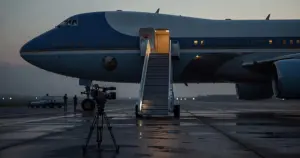
A source told reporters Thursday that the administration will not list CNN as a television pool outlet for the travel, continuing a pattern that already left the network off Air Force One for last Saturday’s Tennessee-Texas college football matchup. Breitbart reported the White House did not immediately respond to a request for comment on the latest exclusion.
CNN spokesperson Emily Kuhn confirmed the removal to NBC News but offered no further statement. The network, along with MS NOW and Politico, has pressed a federal court to force broader access after the White House first moved against their credentials.
That fight now turns on a basic line the judge already drew: access to the White House grounds is not the same as a seat on the president’s travel pool.
Judge restored grounds access, not a travel ticket
A federal judge ordered the three outlets restored to White House grounds after the administration barred them. The order stopped there. It does not require the White House to put CNN on Air Force One or assign it pool duties when the president leaves Washington.
CNN senior reporter Betsy Klein was photographed back on the grounds on September 24, 2026, after the court action. That limited return has not satisfied the network. CNN attorneys renewed a filing on Tuesday claiming the administration has “persisted in unpredictably and inconsistently implementing its ban,” including by keeping CNN off White House pool assignments.
The Trump administration must respond to that filing by Friday, October 2. CNN has called the original exclusion “a blatant violation of the First Amendment and due process” and says the uneven access causes irreparable harm.
The White House has treated travel pool seats as a separate privilege the court did not hand over. That distinction now drives the latest Texas and Oklahoma plan and echoes the earlier decision that kept CNN off Air Force One for the Tennessee football trip.
Trump’s ban started with fake-news complaints
President Trump announced the original restrictions on CNN, MS NOW, and Politico after months of what he described as constant false reporting. In an Oval Office exchange he said of the coverage, “You get sick of it.”
Fox News reported that a senior White House official confirmed journalists from the three outlets would be kept off the grounds beginning that Saturday. Trump framed the step as overdue accountability, not a gag order on the press at large.
On Truth Social he put the reason in plain terms. The ban, he wrote, was because the outlets “are fake news, they cannot tell the truth,” adding that he did not have to let them into “the people’s house.” The New York Post detailed his further comment that he wanted the restrictions to go as far as possible, while acknowledging a court might not uphold every piece of them depending on the judge.
CNN answered that any such ban would be “an illegal assault” on constitutionally protected rights. The White House Correspondents’ Association also objected. Those protests did not erase Trump’s core point: repeated inaccurate coverage has consequences when the same outlets demand permanent access to the executive mansion and the president’s aircraft.
Court block forced a partial readmission
After the outlets sued, a federal court blocked the full removal order. The White House then readmitted CNN, MS NOW, and Politico to the grounds. Just the News reported that CNN’s Kaitlan Collins and the other outlets confirmed the return, and that Trump had already signaled on social media he expected the adverse ruling from D.C. District Judge Tim Kelly.
The readmission covered the complex, not the travel pool. That gap is exactly what CNN’s renewed filing tries to close and what the White House continues to defend. Similar court limits have appeared in other disputes, including a federal judge’s order requiring notice before any Kennedy Center demolition work, where the bench set boundaries without handing the other side every demand.
When the banned reporters first walked back in under the court order, much of the press corps treated the moment like a liberation. The coverage framed a temporary credential dispute as a constitutional crisis, a tone familiar from earlier access fights.
That same press corps later showed how coordinated the pushback can become. After the CNN ban, the major White House television pool networks, ABC, CBS, NBC, and Fox News, issued a joint statement refusing to cover Trump in solidarity with the barred outlet. The Washington Examiner reported the boycott and noted the credential actions against MS NOW and Politico as well.
Networks that routinely compete for scoops suddenly found common cause in denying the public pool coverage of the president. The solidarity gesture underscored the institutional pressure the White House faces whenever it tightens access for outlets it says have failed basic accuracy standards.
Pool seats are not a constitutional entitlement
Nothing in the judge’s order converts a White House travel seat into a permanent right. The administration can still decide which outlets fly on Air Force One and which ones handle pool duty on the road. CNN’s attorneys describe that discretion as unpredictable and inconsistent. The White House treats it as ordinary management of limited space and presidential security.
The network’s First Amendment claim collapses the difference between reporting on the government and demanding a government-provided seat next to the president. Grounds access was restored. Travel pool status was not ordered. The Texas and Oklahoma itinerary simply applies that line again.
Earlier rounds of the same dispute produced the same cycle: White House action, media outcry, court intervention limited to the grounds, then fresh complaints when travel privileges did not automatically follow. Banned reporters returned under court order and the press corps celebrated; the next travel day brought the next exclusion and the next filing.
Taxpayers fund the aircraft, the security, and the logistics. They do not fund a guaranteed berth for every cable network that objects to the president’s tone. When outlets spend years producing coverage the White House calls fake, the administration is not required to pretend those years never happened.
The October 2 response deadline will test how far the court is willing to stretch the original restraining order. Until then, CNN remains off the Texas and Oklahoma pool list, just as it remained off the Tennessee football flight.
Hard questions about accuracy still belong in the newsroom. They do not entitle any network to permanent space on the president’s plane.
