


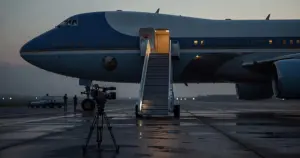
Trump unveils Arsenal-2 in Baltimore as largest new U.S. shipyard since World War II
President Trump launched construction of Arsenal-2 in Baltimore as the largest new U.S. shipyard since World War II, backed by a $6.6 billion push to rebuild submarine production and industrial strength.
President Donald Trump on Tuesday announced the start of work on a major shipyard in Baltimore he described as unmatched in scale for generations. The facility, named Arsenal-2, will rise at Sparrows Point and focus on critical components for Virginia-class attack submarines.
Just the News reported the president framed the project as a direct answer to years of lagging American shipbuilding capacity. Trump said the yard would help the United States expand its submarine force for the current era and pointed to Baltimore’s long record of building ships for American wars.
Defense technology firm Anduril is putting $3.7 billion of its own capital into the project. The federal government is adding billions more in support, bringing the combined package to $6.6 billion. Officials tied a $2.9 billion Navy contract to the effort.
Trump cast the announcement in plain terms.
"Today, we're officially launching the construction of the largest new shipyard in the United States since World War II, there's been nothing like what we're doing today,"
the president said.
Anduril and the Navy lock in $6.6 billion for Arsenal-2
The New York Post detailed a joint federal and Anduril investment totaling $6.6 billion to build Virginia-class submarine components at the new yard. Anduril’s share is $3.7 billion. The Navy’s portion reaches $2.9 billion.
Arsenal-2 is slated to span 2 million square feet. Planners say the plant will produce torpedo tubes and ship sections needed to keep attack-submarine construction on pace. The broader goal is sustaining production of two Virginia-class boats per year.
White House deputy press secretary Anna Kelly tied the deal to a wider industrial push.
"This delivers on President Trump’s promise to bolster America’s defense industrial base while revitalizing our manufacturing industry, creating over 13,000 direct and indirect jobs and driving $2 billion in annual economic output,"
Kelly said.
That kind of large-scale private-public investment echoes other recent manufacturing commitments the administration has highlighted, including when TSMC pledged more chip-factory money in Arizona.
Anduril founder Palmer Luckey underscored the size of the bet.
"Anduril is building America’s largest shipyard since WWII. This space needs bold investment and decisive action,"
Luckey said, according to coverage of the Maryland event.
Taxpayers receive a 40 percent ownership stake
Trump also revealed a structural feature of the deal that puts public money on both sides of the ledger. Fox News reported that the U.S. government will hold a 40 percent stake in the new Arsenal-2 shipyard.
The president presented the stake as proof the yard is meant to last.
"The ultimate proof of our commitment to ensuring the shipyard's enduring success: American taxpayers will receive a 40 percent stake in the new shipyard," Trump said. "We get 40 percent."
Supporters of the arrangement argue it aligns taxpayer interest with long-term production success rather than a one-time grant. Critics of industrial policy often warn about government ownership; here the White House is advertising the stake as a feature, not a bug.
National-security choices of this scale sit alongside other recent moves to reposition U.S. forces and assets, such as when Trump pulled American B-1 bombers from the United Kingdom after a threat to a British base.
Sparrows Point stands to gain thousands of jobs
Breitbart reported the yard is expected to create more than 3,100 jobs in Maryland and support roughly 11,000 more nationwide. Separate tallies put permanent positions above 3,100 and total direct and indirect employment above 13,000, with about $2 billion in yearly economic output.
Fox’s accounting added that the facility should lift Virginia-class production capacity by roughly 15 percent. That margin matters for a Navy that has struggled to meet submarine delivery targets while peer competitors expand their underwater fleets.
Trump linked the project to a simple strategic claim: stronger shipyards mean a stronger Navy, and a stronger Navy support peace.
"We will build the future of America’s navy right here in Baltimore. And it will be a future of peace through strength," the president added. "We have never been a stronger country than we are right now."
Officials also connected Arsenal-2 to a maritime action plan and an executive order aimed at restoring U.S. shipbuilding after years of decline relative to China’s commercial and naval output. The administration wants American yards turning out hulls and components at a tempo the industrial base has not sustained in decades.
Baltimore’s shipbuilding past meets a submarine mission
Trump used the announcement to recall Baltimore’s role in earlier American conflicts. The city once turned out vessels for U.S. wars; Arsenal-2 is meant to put that industrial memory back to work on undersea systems rather than surface fleets alone.
Work at the yard will center on next-generation submarines, including autonomous designs and the components that keep Virginia-class attack boats moving through the pipeline. Exact construction start and completion dates were not spelled out in the initial rollout, nor was a full site address beyond Sparrows Point.
Funding details beyond the headline numbers also remain thin in public remarks. Anduril’s $3.7 billion is described as the company’s capital commitment. The Navy’s $2.9 billion appears as contract authority for purchases tied to the facility. Which federal accounts supply any remaining “billions more” was not broken out in the first-day coverage.
Even so, the political signal is clear. The administration is treating shipbuilding as core national power, not a niche procurement line. That same preference for concrete industrial results over open-ended social spending has shown up elsewhere, including when Trump canceled $810 million in migrant-aid and DEI outlays through a rare pocket rescission.
Readers following the president’s domestic record will also note the contrast with crime and public-order metrics that have drawn unexpected praise from outside the usual coalition, as when Bill Maher credited Trump’s tougher crime approach amid falling violent offenses.
Industrial base repair after years of drift
American submarine construction has faced well-documented bottlenecks in labor, suppliers, and yard capacity. Adding a large new site dedicated to tubes, sections, and related work is one way to widen the throat of that pipeline. A 15 percent capacity bump will not solve every shortfall overnight, yet it is a measurable step rather than another study or task force.
The ownership structure is unusual for a modern defense plant. A 40 percent taxpayer stake means public money is not only a customer; it is a co-owner with a direct claim on the yard’s long-term performance. Whether that model spreads to other critical facilities will be watched closely by both industry and budget hawks.
For Maryland workers, the immediate question is hiring. More than 3,100 permanent jobs at Sparrows Point would mark a substantial reverse of the area’s long industrial contraction. Indirect employment across the supply chain multiplies that footprint into the low five figures if the higher estimates hold.
Trump’s team is selling Arsenal-2 as proof that peace-through-strength rhetoric can be matched with steel, concrete, and payrolls. The test will be whether the yard opens on a useful schedule, delivers the promised components, and helps the Navy hit its two-submarines-a-year target without the cost overruns that have plagued past shipbuilding drives.
America cannot deter rivals with speeches alone; it needs yards that cut steel and workers who know the trade. Arsenal-2 is the administration’s bet that both can be rebuilt in Baltimore.
