


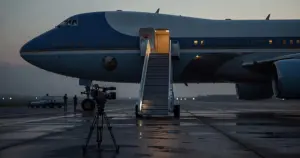
White House announces U.S.-Iran memorandum of understanding, Strait of Hormuz reopens with zero frozen assets released
The United States signed a memorandum of understanding with Iran that provides for the immediate reopening of the Strait of Hormuz, the lifting of the American naval blockade, and the start of a new round of negotiations over Tehran's nuclear program, sanctions relief, frozen assets, and regional security, the White House said Monday.
President Donald Trump, Vice President JD Vance, and Iranian Parliament Speaker Mohammad-Bagher Ghalibaf signed the document. A formal signing ceremony is scheduled for Friday, June 19, in Switzerland, Pakistani Prime Minister Shehbaz Sharif said.
The most striking detail in the announcement: not one dollar of frozen Iranian assets has been released. A senior U.S. official put it bluntly when asked how much had been unfrozen upon signing.
"Zero. $0 of unfrozen assets have been released by the United States or any other country."
That single line separates this framework from the Obama-era Iran deal, which shipped pallets of cash to Tehran before Iran had demonstrated any sustained change in behavior. The Trump administration is insisting on a performance-first structure, and saying so publicly.
What the memorandum actually does
The MOU calls for the "immediate opening of the Strait of Hormuz" and the "combined lifting of the naval blockade," according to Breitbart's reporting on the White House briefing. A senior American official described the document as creating "a structure for how our negotiation, our relationship will operate in the future."
But the official was careful to temper expectations. Mines remain in the strait. Shipping traffic, while "actually starting already" to pick up, will not snap back overnight.
"We probably won't return to normal in two weeks."
The official noted that different shippers and insurers "have different risk tolerances," and that the ramp-up will be gradual as confidence builds. That is a realistic assessment, and a welcome contrast to the kind of sweeping promises that tend to precede diplomatic disappointments.
Performance first, money later
The administration laid out a framework that ties every major incentive to verifiable Iranian action. A senior U.S. official described the possibility of a "big $300 billion fund to rebuild their country", but said it was "tied to performance." Another official said the United States is "prepared to release frozen funds" only after Iran takes "verifiable and hopefully irreversible steps."
Washington's top priority, officials said, is ensuring Iran does not rebuild its nuclear program. The broader offer includes sanctions relief, investment support, and the prospect of Iran being "welcomed into the world economy", but only, officials stressed, if Tehran stops "funding radicalism and terrorism in the region."
A senior official summed up the logic plainly:
"If they're willing to behave like a normal country, then we're willing to treat them like a normal country."
That framing, a "two-way street," as the official called it, is the right instinct. Decades of Western engagement with Iran have foundered on the gap between what Tehran promises and what it delivers. The administration appears to understand that leverage must be maintained, not surrendered at the table.
No drawdown, no Israeli withdrawal required
One of the more significant details: the United States is not yet drawing down forces in the region. A senior official said the administration is holding off on a visible military reduction until "the Iranians make some concessions." That is the correct sequence. You do not remove pressure before the other side has moved.
On the Israeli front, a senior official stated flatly that Israel's "withdrawal is not a condition of the deal." Israel retains the right to respond if Iran cannot control Hezbollah or if Hezbollah attacks Israeli positions or towns. The arrangement, the official said, "will not be a one-way ceasefire."
These are meaningful guardrails. Critics of prior Iran diplomacy have long warned that Washington tends to extract concessions from allies, particularly Israel, while accepting vague assurances from adversaries. The administration appears to be resisting that pattern.
The negotiating team and the diplomatic channel
Vice President Vance played a central role. A senior administration official said Trump encouraged Vance to get "involved directly," calling it "an opportunity to make a difference." Another official said the administration was "really, really lucky to have the vice president leading this team." Jared Kushner and Steve Witkoff were also credited as part of the negotiating effort.
The diplomatic channel itself is notable. A senior official said the administration has built "a direct relationship with a number of people at the highest levels of the Iranian government", something that "really hasn't happened in 47 years." Another senior U.S. official described a multi-track approach involving "front channel conversations with the Pakistanis" and "back channel conversations with the Qataris."
Pakistani Prime Minister Shehbaz Sharif confirmed the broader framework, declaring that "The Peace Deal between the United States of America and Islamic Republic of Iran has been REACHED." Trump himself announced Sunday that the deal was "now complete," adding: "Ships of the World, start your engines. Let the oil flow!"
What remains unresolved
For all the administration's discipline on frozen assets and force posture, significant questions remain. The full text of the MOU has not yet been released, though a senior U.S. official said it "will be released publicly" and promised "there'll be no side deals." The specific verification steps Iran must take, the phased sanctions relief timeline, and the details of any ceasefire terms are still unclear.
Officials acknowledged there is "still a lot of work to do" and "wood to chop." Another senior U.S. official said that over the next two to three weeks, the administration would learn whether current understandings would solidify into a mutual agreement, or whether elements within Iran's "industrial base" and "military" who "want to stay with the same pathway" would prevail over those who "want to change."
That is the central tension. Iran's regime is not monolithic. Hardliners who have spent decades building proxy networks and advancing nuclear ambitions do not simply yield because a document was signed in the presence of a Pakistani prime minister. The MOU is a framework, not a finish line.
The right posture, if held
The administration deserves credit for structuring this agreement the way conservatives have long argued Iran diplomacy should work: leverage first, concessions earned, allies protected, and money released only against verified performance. Zero dollars out the door on day one is the right number.
But frameworks are only as good as the follow-through. The Obama administration also promised verification and performance benchmarks. What followed was a deal that enriched Tehran, empowered its proxies, and left the nuclear question unresolved. The Trump team says it has learned from that failure. The next two to three weeks, and the months after, will show whether that claim holds.
A deal that keeps American leverage intact and Iranian money locked up until Tehran proves it has changed is worth pursuing. A deal that slowly loosens under diplomatic pressure and bureaucratic drift is just the old mistake in new packaging. The difference is execution, and the willingness to walk away if Iran reverts to form.
Promises from Tehran are the cheapest commodity in the Middle East. The only thing cheaper is a Western negotiator willing to accept them at face value.
